Hex
Join your two sides. Someone always wins. Best of 3 boards.
Hex is a two-player connection game on a diamond of hexagons where each player takes one empty hex per turn. Join your two coloured sides with an unbroken chain of your own hexes first to win. A full board always has one winner.
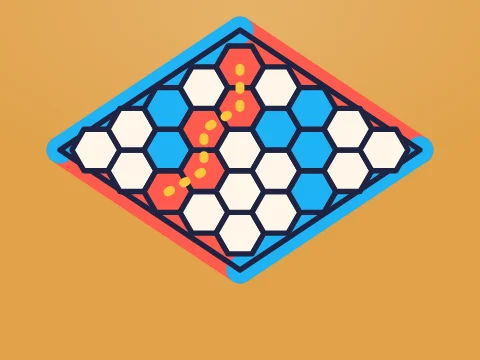
A diamond of hexes, two red edges and two blue. Tap one empty hex a turn; every stone builds your road and blocks theirs. The board can never fill without someone finishing a chain, so every game has a winner.
Also known as Nash, Con-tac-tix, Polygon.

- How you hold it
- Face-off
- Match
- Best of 3 boards
- Length
- About 1 to 2 minutes a board on 7 by 7
- Play
- Friend or bot
How to play Hex: quick rules
About 1 to 2 minutes a board on 7 by 7, 3 to 5 minutes for best of 3; 5 by 5 is about half that, 9 by 9 about double. Full rules, options and bot levels are further down.
- 1Take one hex a turn.
- 2Join your two coloured sides with a chain of your hexes.
- 3Every hex builds your road and blocks theirs.
- 4After the first hex, the other player may swap and take it.
Hex rules
Setup
- The board is a diamond of hexes, 7 by 7 by default (5 by 5 and 9 by 9 are options).
- Each player owns two opposite edges, painted in their colour. Red's are upper-right and lower-left; Blue's are upper-left and lower-right. The board is a mirror image from either seat, so neither side is favoured.
- A coin toss picks who places the first stone of a fresh match; on a rematch the previous loser starts. From the second board on, the loser of the last board starts.
- A 3-2-1 countdown starts each board.
Turns
- On your turn, tap exactly one empty hex. It becomes your stone for the rest of the board.
- There is no pass and no undo. A tap on a taken hex does nothing.
- The last stone placed carries a small dot so you can see what changed.
The swap rule
- With Swap rule on (the default), on move 2 only, the second player may take the opener's stone instead of placing one.
- The stone moves to its mirror cell and turns the second player's colour. The swap counts as move 2, and the opener moves next.
- This stops the first player from winning just by opening in the strongest spot: open too strong and it gets taken.
Winning
- A board ends the moment a player's unbroken chain of stones joins both of their edges. That player wins the board.
- Hex has no draws: a full board always contains exactly one winning chain.
- With Blocker tiles on, a full board with no chain is rarely possible; it is replayed with the other player starting and doesn't count.
- A match is a single board, best of 3 (the default) or best of 5. It never ends drawn.
Hints against the bot
- Playing the bot outside a tournament, you can spend 20 coins on a hint on your turn. It rings, for two seconds, the hex the Hard bot would take for you, or the Swap button when swapping is the stronger reply.
- A hint never plays for you, and you can take one per turn. There are no hints against a friend or in a tournament.
Tips to win at Hex
- 1Start near the centre of the board. A central stone reaches both of your edges and gets in the way of both of theirs.
- 2Use bridges: two stones with two empty hexes between them are as good as joined, because if your rival takes one gap you take the other.
- 3Block from a distance. A stone a few hexes ahead of their chain is harder to get round than one placed right against it.
- 4With the swap rule on, don't open dead centre. Pick a decent but not perfect first hex, so swapping it isn't worth it.
- 5Watch both roads, not just yours. Every stone should lengthen their path or shorten your own, ideally both.
Where Hex comes from
Hex was invented by the Danish mathematician and poet Piet Hein in 1942, and independently by the American mathematician John Nash in 1948. It was sold as Hex by Parker Brothers in 1952 and became a favourite of mathematicians because a game can never end in a draw.
Controls
Phone flat between you. Each player owns a half, and the far half faces the far player.
- Tap an empty hex to place your stone straight away. There is no preview, so look before you tap.
- On move 2, a Swap button appears in the second player's dock. Tap it to take the opener's stone; place a stone instead and the offer is gone.
- Each dock shows a road of small hexes: how close that player's best chain is to joining their edges. The next gap pulses when one hex is needed.
- The phone lies flat between you; each player's dock sits at their own end, facing them.
- 7 by 7 and 9 by 9 are offered on bigger phones; smaller phones play 5 by 5, so every hex stays easy to tap.
Options
Every option is free. Defaults are marked.
| Option | Choices | What it does |
|---|---|---|
| Board | 5 by 57 by 7 (default)9 by 9 | Quick, Classic or Deep. On smaller phones only 5 by 5 is offered, and it is the default there. |
| Boards | SingleBest of 3 (default)Best of 5 | How many boards to win the match. |
| Swap rule | On (default)Off | Extra: on move 2 the second player may take the first stone. |
| Block stamps | On (default)Off | Extra: a stone that stops the rival one hex from connecting stamps "Blocked!". |
| Bridge guides | OnOff (default) | Extra: shows a dashed link between two stones that share two empty neighbours, and flags it when one gap is taken. |
| Blocker tiles | OnOff (default) | Extra: two grey stones that belong to nobody start on each board. |
Play Hex against the bot
The bot plays Blue and sees the whole board, as you do. It counts how many hexes each side still needs to connect and plays to shorten its road and lengthen yours. It pauses to think before each stone.
Easy
Often drops a stone near the last one without much plan, and only sometimes swaps a strong opening stone.
Normal
Always swaps a central opening stone, takes a winning hex, blocks you when you are one hex away and otherwise plays its best-looking hex. Now and then it picks a weaker one.
Hard
Does all of that, rescues its bridges when you cut into them and checks your best replies before it plays. It still slips on rare occasions.
Online, tournaments and hints
- Online
- PlannedOnline play for Hex is planned, not available yet. Today you play a friend on the same phone or the bot.
- Tournament
- Can be drawn in a tournamentIn a tournament it plays the default options: 7 by 7 (5 by 5 on smaller phones), best of 3, Swap rule and Block stamps on. Hints are off.
- Hints
- Stuck against the bot? A hint lights up the strongest move for a few coins. Never with a friend, online or in a tournament.
Coming soon
- Online play. Play Hex against someone on another phone, with a turn clock.
How it feels
- A ceramic clack and a little squash as each stone drops.
- A whoosh as a swapped stone jumps to its mirror cell, and a stamp for "Blocked!".
- The winning chain lights up hex by hex from edge to edge with a rising chime.
Accessibility
- Each player's edges stay fixed in position, the last stone carries a dot, and stickers name events like "Swap!" and "Blocked!".
- One finger, tap only, with no clock on a turn against a friend or the bot.
- With reduce motion on, stones don't squash, the winning chain lights all at once and nothing pulses.
- Every hex has a screen-reader label with its position and owner, and the road in your dock reads how many hexes you still need.
Hex questions
Take turns placing one stone on any empty hex. The first player to join their two coloured edges with an unbroken chain of their stones wins.
No. A full Hex board always has exactly one winning chain, so every board has a winner.
After the first stone, the second player may take it as their own instead of placing a stone. It stops the first player from simply opening in the strongest spot.
Yes. The bot plays on Easy, Normal or Hard, and you can buy a hint with coins against it.
Yes. Hex in Duo Clash is built for two players on the same phone. Phone flat between you. Each player owns a half, and the far half faces the far player.
Not yet. Online play for Hex is planned, not available yet. Today you play a friend on the same phone or the bot.
Play Hex on one phone
Free on Android. Sit face to face, or take on the bot on Easy, Normal or Hard.