Ping Pong
Slide your paddle. Miss the ball, lose the point. First to 7.
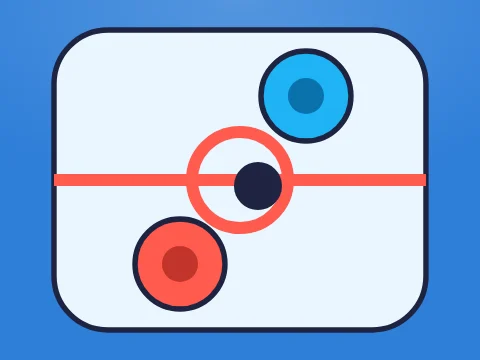
Ping Pong is a two-player paddle game in which you slide your paddle to bounce a ball that speeds up with every hit. Miss the ball and your rival scores, and the first to 7 points wins.
The ball leaves the server, bounces off the walls and gets faster every time it comes back. Hit it while your paddle is moving and it flies off at a new angle, so no rally plays the same way twice.
Also known as Table tennis, Pong, 2 player ping pong.

- How you hold it
- Face-off
- Match
- First to 7
- Length
- About 1 to 2 minutes
- Play
- Friend or bot
How to play Ping Pong: quick rules
About 1 to 2 minutes at first to 7. Full rules, options and bot levels are further down.
- 1Drag anywhere on your half to slide your paddle.
- 2Bounce the ball back or your rival scores.
- 3The ball gets 4% faster with every hit.
- 4Move your paddle as you hit to add spin.
- 5First to 7 wins, and the loser serves next.
Ping Pong rules
Setup and serve
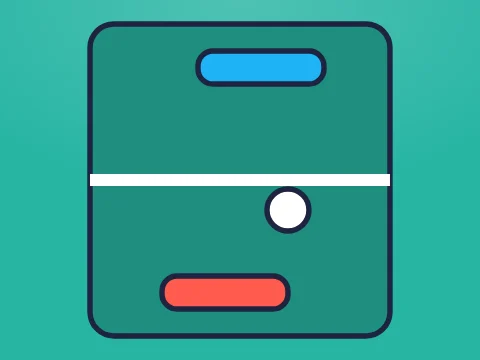
- Red plays from the bottom end and Blue from the top, with Blue's half turned to face the top player. Each paddle slides along a line in front of its own end of the table.
- The first server is picked at random, and the banner during the countdown names them. Against the bot it reads “Tap to serve” or “Bot serves”.
- After GO the ball sits on the server's paddle and moves with it. Tap anywhere in your half to serve; if you haven't served after about three seconds, the ball serves itself.
- A finger already down before GO doesn't count: lift and touch again. After every point, the player who missed serves the next one.
The rally
- Every return makes the ball 4% faster, up to a top speed. Bounces off the side walls never change its speed.
- Where the ball meets your paddle sets its angle: a centre hit goes straight, an edge hit goes wide. Sweeping the paddle as you hit adds spin, which bends the return angle further. The ball doesn't curve in flight.
- Once the ball has passed behind your paddle, it can't be returned.
- Ball speed and the return count reset at every serve. From ten returns a “Rally” counter appears for both players.
Scoring and long points
- You score when the ball crosses the other player's end line.
- In a very long rally both paddles start to narrow a little with every return, by the same amount for both, so the point always ends.
- If a point still won't end, it is called off with “No point — go again!” and the same player serves again.
- Pausing or leaving the app mid-rally freezes the ball. After a fresh countdown the rally carries on from exactly where it stopped, so pausing can never save a point.
Winning
- First to the target wins: 5, 7 or 11 points. There is no draw and no win-by-two.
- On a rematch, the player who lost serves first.
Ball speeds
- Chill
- A slower ball, for new players and relaxed rallies.
- Normal
- The default speed.
- Fast
- A quicker ball from the first serve, for sharp reflexes.
Tips to win at Ping Pong
- 1Aim with the edge of your paddle. A centre hit goes straight back, while an edge hit sends the ball wide toward a wall.
- 2Sweep your paddle as you hit to add spin and bend the return, so your rival has to cover more ground.
- 3Use the walls. A return that bounces twice can beat the Normal bot, which only reads one bounce.
- 4After a hit, slide back toward the middle so you're ready for either side.
- 5In long rallies the ball keeps getting faster and the paddles narrow, so stay calm and keep your returns safe rather than flashy.
Where Ping Pong comes from
Table tennis began in England in the 1880s as an after-dinner parlour game, played with improvised bats and balls on a dining table. The name Ping-Pong, from the sound of the ball, was popular around 1900, and the sport spread worldwide during the 20th century.
Controls
Phone flat between you. Each player owns a half, and the far half faces the far player.
- Touch anywhere in your half and drag sideways. The paddle moves as far as your finger moves, from wherever it is; it never jumps to your finger.
- The paddle has a top speed, so a frantic swipe can't make it teleport.
- Lift your finger and the paddle stays where it is.
- One finger per player moves the paddle. While you serve, a tap with a second finger serves without moving the paddle.
Options
Every option is free. Defaults are marked.
| Option | Choices | What it does |
|---|---|---|
| Points to win | 57 (default)11 | The score that wins the match. |
| Ball speed | ChillNormal (default)Fast | Sets how fast the ball starts each point; its top speed rises with it. |
Play Ping Pong against the bot
The bot plays Blue under the same paddle speed limit and rules as a person. It watches the ball coming toward it, predicts where it will arrive, wall bounces included, and slides across to meet it. It never moves before GO, never reads your finger and never sees the serve angle before the ball is served. Its aim gets a little less sure as a long rally speeds up.
Easy
Often reads no bounce at all, hits everything from the centre of the paddle, so its returns are predictable, and sometimes pauses while the ball travels away.
Normal
Reads one bounce, so a ball that bounces twice can beat it. It places some returns away from your paddle and adds spin now and then.
Hard
Reads two bounces and rarely misses early in a rally, but misses more as a long rally speeds up. A well-placed fast return off the walls and varied spin can still beat it.
Online, tournaments and hints
- Online
- One phone onlyPing Pong is real-time physics, and internet delay would decide every return, so it stays on one phone.
- Tournament
- Can be drawn in a tournamentIn a tournament it is always first to 7 at Normal ball speed, whatever your saved options.
- Hints
- No hints here: it's all about your own reactions.
How it feels
- A short wooden pock on every return, rising in pitch as the rally goes on.
- A rising crowd cheer at 10, 20 and 30 returns, and a trail behind the ball once a rally runs long.
- The ball squashes on each hit and the paddle recoils a touch; a soft tap and a little dust ring mark each wall bounce.
- “Point!” for the scorer and “Missed it” for the other player, each upright from their own side.
Accessibility
- Colour is never the only cue: Red's paddle carries a dot and Blue's a diamond, and the ball is a light disc with a dark outline.
- Drag works anywhere in your half, so either hand, or one hand, can play a whole side, and the serve is a tap anywhere in your half.
- With Reduce flashing on, the ball trail and dust are off, the squash is smaller and banners fade in.
- Ping Pong is a real-time game and can't be played with a screen reader.
Ping Pong questions
Ping pong is another name for table tennis. In Duo Clash it is a quick top-down version: each player slides a paddle at their end of the phone and tries to get the ball past the other.
Move your paddle sideways as the ball hits it. The sweep bends the return angle, though the ball doesn't curve in flight.
No. The first player to reach the target, 5, 7 or 11 points, wins, and there is no win-by-two.
Yes. Every return makes the ball 4% faster up to a top speed, and the speed resets at every serve.
Yes. Ping Pong in Duo Clash is built for two players on the same phone. Phone flat between you. Each player owns a half, and the far half faces the far player.
Yes. The bot plays Blue under the same paddle speed limit and rules as a person. Choose Easy, Normal or Hard.
Play Ping Pong on one phone
Free on Android. Sit face to face, or take on the bot on Easy, Normal or Hard.