Memory Match
Flip two cards. Find more pairs than your rival. Most pairs.
Memory Match is a two-player card-matching game in which you flip two cards per turn, keeping your turn whenever they show the same picture. Cards that don't match flip back, and the player with the most pairs wins.
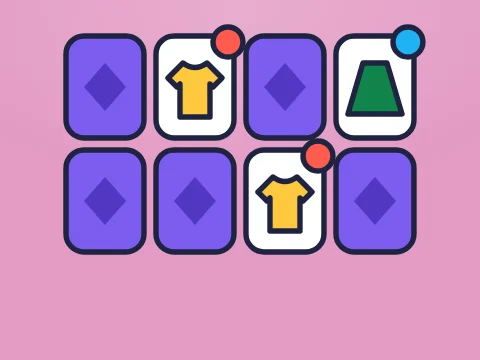
Flip a card, then another. A pair keeps your turn and flies to your tray; a miss hands the phone over to a rival who has just seen the same two cards. Whoever remembers best wins.
Also known as Concentration, Pairs, Pelmanism, Matching pairs, Memory card game.
- How you hold it
- Pass and play
- Match
- Most pairs
- Length
- About 1 to 2 minutes on 4 × 4
- Play
- Friend or bot
How to play Memory Match: quick rules
About 1 to 2 minutes on 4 × 4, and about 3 minutes on 6 × 6. Full rules, options and bot levels are further down.
- 1Tap one card, then a second, to flip them over.
- 2Two of the same picture make a pair, and you go again.
- 3Different pictures flip back and your rival takes a turn.
- 4Remember where things are, because most pairs wins.
- 5A tie goes to a flip-off where the fastest pair wins.
Play Memory Match here
Two of you on this screen, or you against the bot. The full game is in the app.
Memory Match rules
The board and the first turn
- Every picture is on exactly two cards. The pictures and their places are shuffled fresh for every game, including a rematch, so nothing carries over.
- A coin flip picks who goes first in a new match, and the banner names them during the countdown. On a rematch, the player who lost goes first.
- The countdown runs once, before the first turn. After that, turns follow straight on.
A turn
- Flip one face-down card, then a second. You can't flip a third.
- A pair stays yours: the two cards fly to your tray, the banner says “Pair! Go again” and you flip again. You can find any number of pairs in a row.
- Not a pair: both cards stay up for about a second for everyone to see, then turn back over, and the turn passes.
- Tapping the card that is already up only gives it a little shake, so you can never pair a card with itself.
- A drag, a swipe or a long press doesn't flip a card, and taps are ignored while cards are moving.
Winning
- Each pair is worth one. The screen shows both trays and how many pairs are left.
- The game ends as soon as one player has more than half of all the pairs, because the other can no longer catch up: 5 of 8 on 4 × 4, 6 of 10 on 4 × 5, 10 of 18 on 6 × 6.
- There is no draw. Exactly half each goes to a flip-off.
The flip-off
- Each player gets their own fresh board of 12 cards, shuffled differently, and plays it alone against the clock.
- The player who didn't take the last turn goes first. A “get ready” card with a Ready button comes before each attempt, then a countdown.
- Flip until you find a pair; a miss just flips back and you keep going. The clock stops on your pair, or at 20 seconds.
- The faster time wins, and both times are shown. If the times are practically equal, or both reach 20 seconds, the flip-off is played again in the other order; after repeated ties a coin toss settles it, so the game always ends.
Grids
- 4 × 4
- 16 cards, 8 pairs. The default, and the quickest game.
- 4 × 5
- 20 cards, 10 pairs.
- 6 × 6
- 36 cards, 18 pairs, for a longer test of memory. Cards still fit the screen without scrolling.
Tips to win at Memory Match
- 1Watch your rival's turns as closely as your own. Every miss they make shows you two cards for free.
- 2Flip a card you haven't seen first. If it matches one you remember, you can take the pair with your second flip.
- 3If your first card is new and you don't know its match, flip a card you've already seen as the second, so you don't reveal fresh information to your rival.
- 4Remember positions by rows and corners, such as “apple, top row, second from left”, instead of trying to picture the whole grid.
- 5Keep count of pairs: once someone has more than half, the game ends at once.
Where Memory Match comes from
Memory Match follows a long-standing card game known as Concentration, Pairs or Pelmanism, in which a deck is laid out face down and players turn up two cards at a time looking for matches. The name Concentration was made popular by an American TV game show of the same name that began in 1958.
Controls
Upright, handed back and forth. A banner in the mover's colour says whose turn it is.
- One tap per card. Pass the phone when the turn changes; the banner and background tint switch to the player whose turn it is.
- Only the first finger counts. A second finger is ignored until the first lifts.
- During the bot's turn, taps on the grid do nothing.
Options
Every option is free. Defaults are marked.
| Option | Choices | What it does |
|---|---|---|
| Grid | 4 × 4 (default)4 × 56 × 6 | Sets how many cards, and so how many pairs, are on the board. |
| Theme | Fruits (default)AnimalsEmoji | Changes the pictures on the cards; every picture has its own shape. |
Play Memory Match against the bot
The bot plays Blue and never peeks: it only learns from cards that have been turned up, yours and its own. When it remembers both cards of a pair, it takes them; otherwise it tries a card it hasn't seen. It flips at a human pace.
Easy
Forgets most of what it sees and mostly guesses, so a first-timer can beat it.
Normal
Remembers many of the cards it has seen, and now and then misses a pair it has already seen.
Hard
Remembers almost everything, but still forgets the odd card, so it can lose a close board.
Online, tournaments and hints
- Online
- One phone onlyMemory Match plays on one phone; online play is for Tic Tac Toe and 4 in a Row today.
- Tournament
- Can be drawn in a tournamentIn a tournament it is always the 4 × 4 grid with Fruits, whatever your saved options, and the first mover alternates from game to game.
- Hints
- No hints here: a hint would just be a peek at the cards.
Coming soon
- Longer show time. An option to keep a missed pair face up a little longer before it flips back, for slower players.
How it feels
- A card snap on every flip, a little higher for the second card.
- A bright chime and a sparkle as a pair flies to your tray, with the chime climbing as your streak grows.
- A soft tap and a small shake for a miss, and a whoosh as the turn changes.
- A drum roll for “Tie! Flip-off”, and a fanfare for the winner.
Accessibility
- Pictures differ by shape, not only colour, and each player's tray and found-card slots carry their pawn's shape as well as their colour.
- With reduced motion, flips become a quick fade and found pairs fade instead of flying, with no sparkles.
- Cards stay large on every grid, and one tap per card is all it takes.
- With a screen reader, a turned-up card reads its picture and a face-down card reads only “face down”.
Memory Match questions
Yes. It plays like the classic Concentration or Pairs card game: flip two cards, keep them if they match, and the player with the most pairs wins.
Yes. A pair keeps your turn, and you can find any number of pairs in a row. A miss passes the turn.
No. If both players finish with exactly half the pairs, a quick flip-off on a fresh 12-card board decides the winner.
Pay attention to every card your rival turns up, and flip an unknown card first so your second flip can use what you remember.
Yes. Memory Match in Duo Clash is built for two players on the same phone. Upright, handed back and forth. A banner in the mover's colour says whose turn it is.
Yes. The bot plays Blue and never peeks: it only learns from cards that have been turned up, yours and its own. Choose Easy, Normal or Hard.
Play Memory Match on one phone
Free on Android. Sit face to face, or take on the bot on Easy, Normal or Hard.